

Physicists Discover What Happens Inside a Stable Vortex
Large vortices with characteristic spiral arms are often observed in the atmosphere and the ocean. Physicists from HSE University have explained how these structures form and why they retain their shape. The researchers found that velocities at points located along the same vortex arc remain correlated even over long distances. At the same time, this correlation weakens rapidly with increasing distance from the vortex centre. These differences help explain the formation of spiral arms and may improve models of atmospheric and oceanic currents. The findings have been published in Physical Review Fluids.

Physicists at HSE University Reveal How Vortices Behave in Two-Dimensional Turbulence
Researchers from the Landau Institute for Theoretical Physics of the Russian Academy of Sciences and the HSE University's Faculty of Physics have discovered how external forces affect the behaviour of turbulent flows. The scientists showed that even a small external torque can stabilise the system and extend the lifetime of large vortices. These findings may improve the accuracy of models of atmospheric and oceanic circulation. The paper has been published in Physics of Fluids.
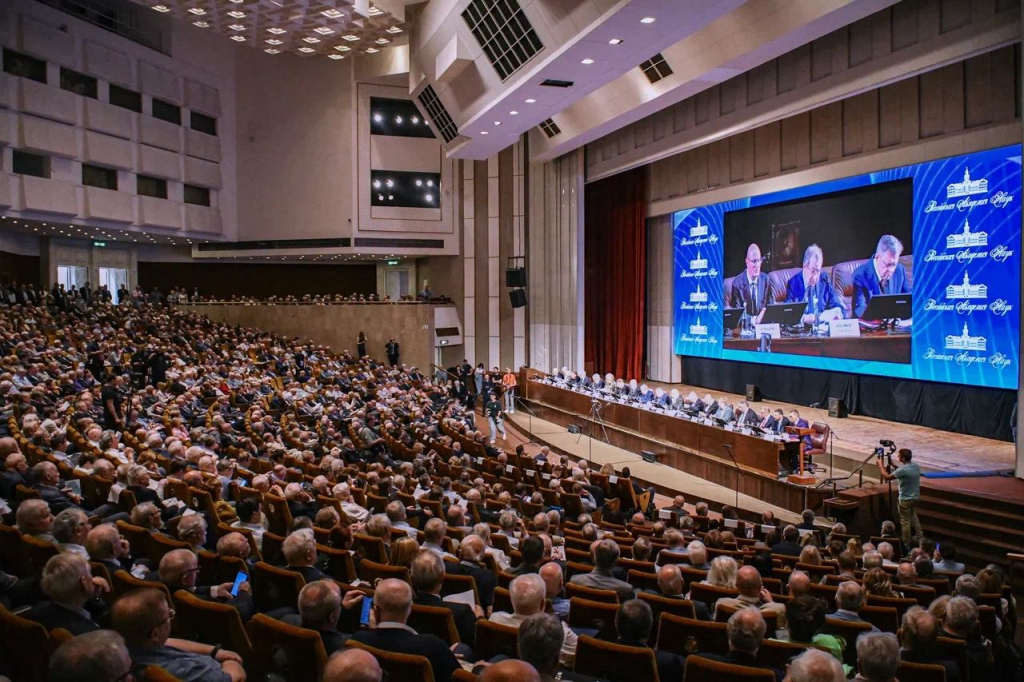
HSE Scholars Elected to Russian Academy of Sciences
On May 30, 2025, a general meeting of the Russian Academy of Sciences (RAS) announced the results of the elections for its full and corresponding members. Around 1,800 individuals took part in the voting. Among those elected this year are scholars from HSE University.

First Successful Attempt in 55 years: Physicists in Russia and Germany Confirm 1969 Experiment Results
A team of researchers, with the participation of physicists from HSE University, replicated the 1969 experiment on superconductivity and its properties. The scientists induced superconductivity by deliberately deteriorating the interfaces between the layers of superconductors and ferromagnets in the system, resulting in better performance of spin valves compared to the classical version, where the interfaces between the layers are ideal. This approach could lead to the development of more efficient devices for data storage and computing. The study findings have been published in the Beilstein Journal of Nanotechnology.
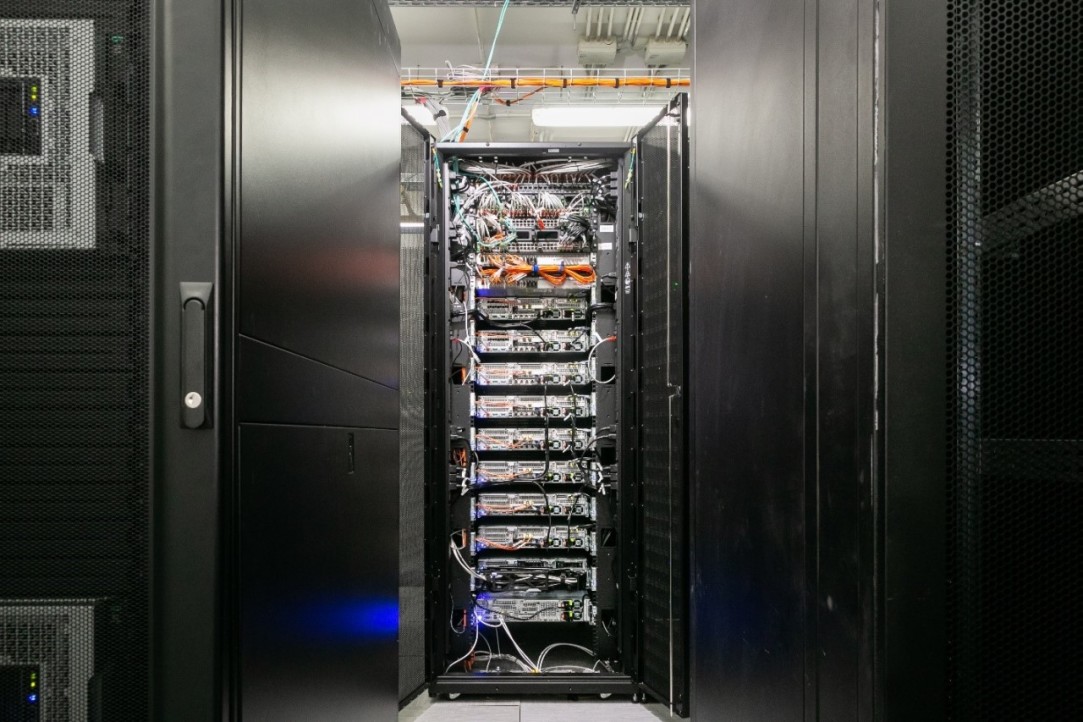
HSE cHARISMa Supercomputer Completes One Million Tasks
Since 2019, the cHARISMa supercomputer has been helping staff, teachers and students of HSE university to solve research tasks. In February 2023, it completed its millionth task—a computational experiment dedicated to studying the phenomenon of multiparticle localisation in quasi-one-dimensional quantum systems.
Post-doctoral positions
The Condensed-Matter Physics Laboratory invites applications for postdoctoral research positions in the field of condensed-matter physics. The deadline for the application is February 14, 2023.
Post-doctoral positions
The Condensed-Matter Physics Laboratory invites applications for postdoctoral research positions in the field of condensed-matter physics. The deadline for the applications is January 31, 2022.
Post-doc positions
The Condensed-Matter Physics Laboratory invites applications for postdoctoral research positions in the field of condensed-matter physics. The deadline for the applications is February 14, 2021.